
According to Microsoft, knowledge workers’ usage of AI more than doubled in 2024, and 3 in 4 workers now regularly use generative AI. Undoubtedly, there’s some good news. Users said AI helps:
- Save time (90%)
- Focus on their most important work (85%)
- Be more creative (84%)
- Enjoy their work more (83%)
But there’s dark side to AI for knowledge workers. Most obviously, unemployment. After Shawn K, a 40-something unemployed programmer, wrote a blog post in May of 2024 blaming AI for failure to land a job after 900+ unsuccessful applications, his diary went viral. Chatter surged about the Great Replacement, in which AI replaced programmers and other knowledge workers.
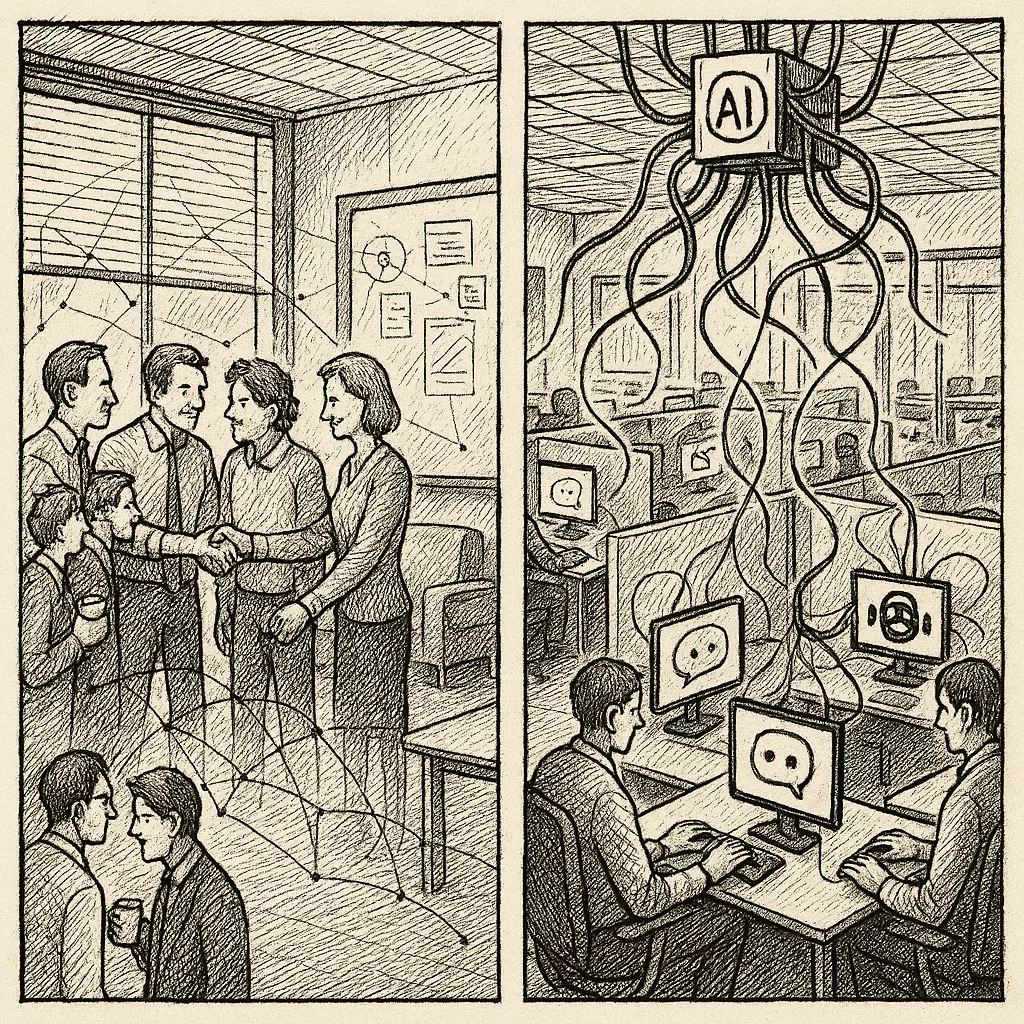
The AI-takes-human-jobs phenomenon is ugly, but it masks a wider and less obvious trend… rising loneliness, alienation and burnout due to AI’s replacement of colleague-to-colleague interactions. The ready availability of always-on and always-eager-to-please AI means knowledge workers are tapping into their professional and workplace networks less often for answers, suggestions and guidance.
And GenZ, many of whom now work from home and have never experienced the camaraderie of a shared workplace, are particularly prone to using AI. According to the Microsoft study, GenZ is 16% more likely than Boomers to use AI.
A recent study of AI’s effects on knowledge workers interactions found that:
Employees who engage in AI collaboration experience elevated levels of loneliness as a consequence of diminished interaction with their colleagues. As a consequence of the replacement of tasks that originally required interaction and collaboration among employees with AI collaboration, the collaboration between employees and AI reduces the communication and interaction of employees with others.
Deprived of human contact, humans may feel like robots engaged in intellectual strip-mining. As Charlie Warzel wrote in the Atlantic:
Workplace AI feels like the purest distillation of a corrosive ideology that demands frictionless productivity from workers: The easier our labor becomes, the more of it we can do, and the more of it we’ll be expected to do.
Employees who frequently use AI are 28% more likely to experience burnout than staff who never use AI.
And yes, the drawing above is a case in point: to get something done quickly, I asked AI to make that drawing rather than going back and forth with a designer colleague.
For related thinking, see our posts on surging loneliness among knowledge workers, and how Racery’s virtual challenges foster employee connection and belonging.
What should organizations do to counter AI-triggered loneliness and disconnection? The authors suggested that companies should “consider the creation of diverse social activity platforms, such as virtual social spaces, interest communities, and team-building activities.”
Racery’s virtual challenges offer on such social activity platform, providing myriad opportunities for colleagues to interact and collaborate over the course of a race spanning days or weeks. To learn more about Racery, contact us for a meeting.